
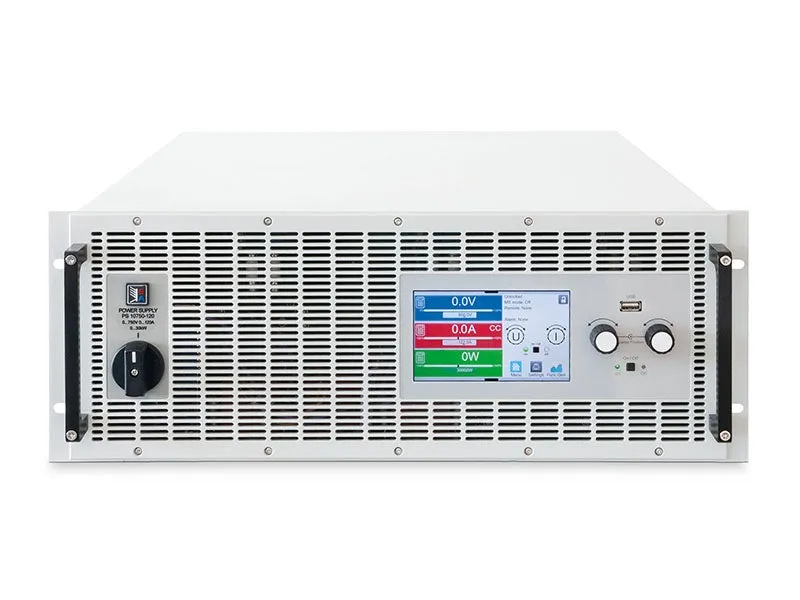
Elektro-Automatik EA-PSBE 10920-125 програмований двонаправлений БЖ постійного струму
Elektro-Automatik EA-PSBE 10920-125 Programmable Bidirectional DC Power Supply
Запитати ціну
Elektro-Automatik EA-PSBE 10920-125 — 30 kW bidirectional DC power supply with 0-920V/125A output and up to 96% energy recovery efficiency.
Деталі продукту
| Модель | EA-PSBE 10920-125 4U |
| Виробник | Elektro-Automatik |
| Категорія | Блоки живлення та електронні навантаження |
| Наявність | На замовлення |
Опис
Огляд
Elektro-Automatik EA-PSBE 10920-125 — це 30 кВт двонаправлений програмований БЖ постійного струму для лабораторних і промислових тестових застосувань. Цей повнофункціональний блок поєднує функції джерела живлення та електронного навантаження з високоефективним відновленням енергії, що дозволяє гнучко тестувати акумулятори, паливні елементи та силові електронні пристрої.
Основні характеристики
- Двонаправлена робота з плавним перемиканням режимів джерела і навантаження
- Відновлення енергії з ефективністю до 96%
- Діапазон виходу: 0-920В, 0-125А при 30 кВт
- Вбудований генератор функцій з програмованими сигналами (синус, трикутник, квадрат, трапеція, рампа)
- Режими тестування та імітації акумуляторів включаючи паливні елементи та фотоелектричну імітацію
- Автомобільні тестові процедури для LV123, LV124 та LV148
- 5-дюймовий сенсорний дисплей TFT з інтуїтивним інтерфейсом користувача
- Цифрова регулювання з 16-бітними ADC та DAC
- Множинні комунікаційні інтерфейси: USB, Ethernet, CAN, CANopen, RS232, Profibus, EtherCAT, Profinet, Modbus
- Шина Master-Slave для паралельного підключення (до 64 пристроїв, розширюється до 1920 кВт)
Застосування
- Тестування акумуляторів та оцінка стану здоров'я (SOH) для електричних транспортних засобів
- Імітація акумуляторів та оцінка другого життя
- Характеризація паливних елементів та стеків паливних елементів
- Тестування встроєного зарядного пристрою (OBC)
- Тестування сонячних фотоелектричних інверторів з MPPT імітацією
- Переробка акумуляторів та управління розрядженням
Характеристики
| AC Connection | The bidirectional DC power supplies in the PSB 10000 series are equipped with an active PFC which provides a high efficiency at a low energy consumption. Furthermore, the devices in this series provide a wide input voltage range. This extends from 1-phase 110/120 V up to 240 V AC mains supply and 3-phase 208 V to 380 V, 400 V and 480 V AC mains supply. The devices can be operated in the majority of global mains supply. They adjust automatically, without additional configuration, to the available supply. In a 110/120 V and 208 V AC grid a derating of the output power is set. |
| Energy Recovering | The energy consumed in load mode is fed back into the connected mains supply with an efficiency of over 96 %. This reduces cost: as the energy is not converted to heat as in other loads, the energy costs are reduced. In addition, the devices generate less heat requiring less cost intensive air conditioning. One device is sufficient for the whole application, reducing investment and installation costs. |
| DC Output | The output of the bidirectional power supply PSB 10000 with a DC voltage of 0 - 10 V up to 0 - 2000 V allows positive and negative currents of 0 - 6 A up to 0 - 1000 A as a two quadrant device. The flexible output stages (autoranging) provide the user with a wide voltage, current and power range and hence a wider field of working than traditional power supplies. |
| DC Connection | Connection of the DC output is via a copper rail on the back side of the device. If a system with higher performance is required, the devices are simply connected in parallel. With minimal effort devices can be linked with the vertical copper rails. A cover for contact protection is provided. |
| Function Generator | All models in the PSB 10000 series are equipped with a function generator. This allows waveforms such as sine, triangle, square or trapeze to be simply called up and applied to either the voltage or the current. A ramp function and a arbitrary generator allow voltage and current progression to be freely programmable. Test sequences for repeated tests can be saved and reloaded when needed, which saves time. A LUT allows IU and UI reference lines to be stored. For simulation of a photovoltaic system or fuel cells, adaptable tables are provided. With the standard PV characteristic curve (DIN EN 50530) various solar cells and many other technology parameters can be selected and set. In short, the user is supported by a multitude of useful functions. |
| Interfaces | As standard EA devices are fitted with the most important digital and analogue interfaces and ports which are galvanically isolated. These include an analogue interface which can be parameterised for input and output, control and monitoring, of 0 - 5 V or 0 - 10 V for voltage, current, power and resistance, assorted inputs and outputs as well as USB and ethernet ports. The following options which use a Plug & Play slot, complete the portfolio: ▪ CAN ▪ CANopen ▪ RS232 ▪ Profibus ▪ EtherCAT ▪ Profinet, with one or two ports ▪ Modbus, with one or two ports ▪ Ethernet, with one or two ports |
| High Performance Systems | High power applications can be covered with high power systems of up to 1920 kW. These are achieved by using the outputs of many PSB 10000 devices, changing the copper rails to vertical, and connecting in parallel. Thus, a 19” cabinet with 42 U can provide a system with 240 kW occupying 0.6 m² floorspace. The master/slave bus enables up to 8 cabinets with a maximum of 64 units of 30 kW each to behave as one unit. |
| Master-Slave-Bus and Share-Bus | If the integral master-slave bus and share bus are used, a multi device system behaves as a single device. The masterslave bus and the share bus are simply connected to each device. With the master-slave bus the system data such as total power and total current are collected and shown in the master device. Warnings and alarms of the slave devices are shown clearly in the display. The share bus provides an equal load distribution to the individual devices. |
| Battery Test for Electro Mobility | A typical application for the bidirectional power supplies from EA Elektro-Automatik is the testing of the electrical characteristics of a battery. The wide application spectrum covers cell, module or pack tests, the determination of the SOH (State-of-Health) for a second life classification as well as the End-of-Line (EOL) test. These applications put many demands on power electronics which are fulfilled by the PSB 10000 range. The excellent features of this device range are: measurement of voltage and current with the required accuracy and performance, reproducibility and reliability of these data and the flexible usebility. Whether in an automated test system or in an integrated battery test, all possibilities are open to the user. Furthermore, the devices are clearly economical with efficiencies of 96% or more. |
| Battery Simulation | Additional applications include the simulation of batteries as single cells, modules, or packs. These simulations aid in the optimal configuration of energy storage as well as the supplied components under test. Wherever reproducible data are needed a battery simulator is the first choice. Also, the use of a simulator as a power source provides protection for the connected consuming component. The OverCurrent-Protection (OCP) can, like a safety fuse, switch off the output and generate an alarm. The voltage can be monitored and can, if over or under limits, trigger various functions, and also generate warnings and alarms. Thus, many integrated functions can be safely performed. |
| Fuel Cell Test | The devices in the PSB 10000 range may be used for testing the electrical features of fuel cells, fuel cell stacks and fuel cell systems. Here they generate highly accurate and reproducible results in all electrical modes. To test the resistance, performance, and active life of a fuel cell quickly and economically users can readily incorporate the devices into an automatic test system. The feedback capability guarantees high level of energy and cost efficiency. If higher currents are needed for testing a complete fuel cell system, then multiple devices can be connected in parallel in a master-slave system. Here high accuracy and performance are maintained. |
| On-Board Charger Test | In an on-board charger test (OBC) the electrical features must be tested under various conditions. This requires a flexible test system which also provides test data. With the sequencing and logging functions of the PSB 10000 devices test procedures allow data to be exported and saved. In this way applications can promptly generate reproducible test results based on dynamic and highly accurate set point and measurement data. To avoid competition between two separate control loops of the device under test (DUT) and the test device, the control frequency of the power supply is adjustable. The modes Normal, Fast and Slow allow the PSB 10000 devices to match the control characteristics of the on board charger. |
| Solar Array Simulation | The programmable power supplies of the PSB 10000 range are highly suited to use as test systems for PV inverters as they can provide the necessary simulation for solar cells. Users can readily program simulation models according to EN 50530 or Sandia using diverse solar cell materials. An IU curve can be accurately reproduced, parameters such as irradiation, shadow, temperature, clouds, and rain can be included. Thus, the devices can test all the relevant electrical features of a PV inverter including the particularly important determination of the efficiency. Users can select a static or dynamic Maximum-Power-Point-Tracking (MPPT). The high resolution of 16-bit technology and a sampling rate of 1µs enables the programmable power supply to deliver accurate results which can be documented and saved to an Excel file. |
| Battery Recycling | The bidirectional power supplies of the PSB 10000 range enable retired batteries from electric vehicles to be considered for a possible further use. Assessment of the battery pack starts with a State of Health (SOH) check to determine if a second life is feasible. This standard integral function can be initiated with one clic. If this check shows too little rest capacity, then the battery must be fully discharged before recycling. The autoranging of the devices guarantees the maximum possible total discharge though the high load current, even with voltages under 2 V. The mains feedback to the power grid at 96% efficiency makes this process highly cost effective. |
| Feature | Description |
| Product Type | DC Laboratory Power Supply |
| Housing | 19" rack |
| Voltage (U) | 920 |
| Current (I) Ampere | 125 |
| Power (P) Watt | 30000 |
| Resistance (R) | No |
| Characteristic Curve | U/I/P autoranging |
| Human Interface | Touch panel & Menu |
| ext. control - analogue 0-5V/0-10V | Yes |
| external control - GPIB (IEEE488) | No |
| external control - USB | Yes |
| external control - RS232 | Yes |
| external control - CAN | Yes |
| external control - LAN | Yes |
| external control - Profibus | Yes |
| external control - DeviceNet | No |
| external control - Modbus TCP | Yes |
| Function Generator | Yes |
| Special Feature - High-Speed | No |
| Special Feature - Sink | No |
| Special Feature - water cooled | No |
| PSB 10920-125 | Voltage Range: 0 - 920 V Current Range: 0 - 125 A Power Range: 0 - 30000 W Resistance Range: 0.25 Ω - 550 Ω |
Запит ціни
Elektro-Automatik EA-PSBE 10920-125 програмований двонаправлений БЖ постійного струму
Відповідь протягом 24 годин
Без зобов'язань
Пряма комунікація